

Changing HVAC filters, cleaning gutters, inspecting smoke alarms. All the maintenance-type stuff that’s genuinely a chore, really important to keep up with, and so easy to lose track of, especially for a vacation rental where you’re not physically there every day. So how do you build a system that actually gets these things done?
My background here comes from hosting two Airbnbs, running a long-term rental, and owning and living in two homes of my own. I’ve made plenty of mistakes, some more expensive than others.
When I bought my first house, I remember Googling “how to maintain a home” and finding a few lists, but it was hard to tell what was overkill. Do you really have to clean the gutters? What actually happens if you don’t? What’s the bare minimum before it turns into a costly problem?
A plain list also doesn’t remind you of anything.
What I really wanted was a practical, comprehensive checklist I could take notes on, one that tracked dates too: when did I last change the HVAC filter, what size was it, and can something remind me when it’s due again?
After much procrastination, I finally built a shareable to-do board to help you skip the mistakes I made. At a high level, it’s a combination of a to-do list, a calendar, and a notepad, and it’s shareable, so you can bring in a business partner or your significant other. It works for both a primary residence and a vacation rental.
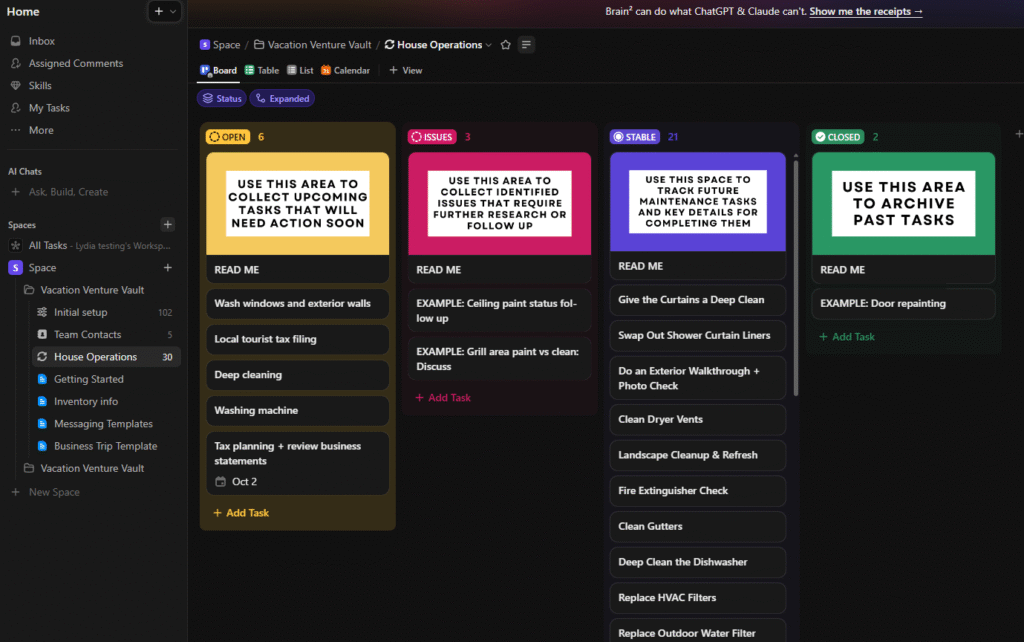
My goal with this board was simple: to never have to consciously think about when something is due again. I just wanted a system that reminds me, so it gets done.
One note before we get into it: these are the frequencies and systems that work for me, not professional advice. Every home, climate, and setup is different, so treat this as a starting point.
The Initial Setup
If you already own your home, feel free to skim this part as a refresher. This is the groundwork you’ll want to start on before closing.
Basic Utilities
These are the essentials to get connected first:
- Electric. Straightforward to set up, unless you’re running your own solar and battery.
- Gas. This might be a simple connection you pay as you go, or a tank rental where you rent the tank and pay them to refill it. The tank rental route usually requires a full safety inspection before you sign, so budget time for that. (Our Florida house was a tank rental.)
- Water. Either a connection to city water or a well. If it’s a well, find out whether you own it, where it sits on the property, whether it’s shared with neighbors, who services it, and how billing works. You want this sorted before the day the water pressure drops and you’re scrambling to figure out who to call.
- Sewer. Usually a connection with a simple monthly bill, but some properties have a septic tank, which again may be yours alone or shared. Either way, find out who inspects it and removes the waste.
- Internet. Compare your local options and pick what fits. If it’s a short-term rental, test the WiFi in different rooms early. You can highlight strong speeds in your listing, and you’ll catch weak spots before guests do. Our beach house had a strange quirk where the WiFi would kick off around the 11th or 12th connected device, which is a nightmare when one of those devices is a WiFi lock or keypad.
- Trash and recycling. Usually the same company. Get the bins delivered, note the pickup days (so you can pass them to cleaners and guests), and if your area has stricter recycling rules, write down the exact instructions.
Services to Line Up
Beyond utilities, there are a handful of services worth connecting with as soon as you close:
- Cleaning company. Obvious for a short-term rental. If you can interview cleaners during setup and walk the space together, that’s ideal for setting expectations. Even for a personal residence, an initial move-in clean is nice. Use the board to note what you agreed on: payment, schedule, what’s included, and upcharges for trash, laundry, or deep-clean items like the fridge, oven, and inside of the washing machine.
- HVAC technician. You’ll be doing routine maintenance later anyway, so it’s worth having someone inspect the system early to confirm you’re starting from a good place. While you’re at it, document your filter sizes, and note that if you have two units, they can take different sizes.
- Pest control. Pests vary a lot by climate, so this can be wait-and-see. Here in Minnesota we skip a pest company and just call for the occasional wasp nest, but in humid places like Florida it’s pretty standard. Two good ways to gauge whether you need it: check the seller’s disclosure for an existing pest contract, and ask your neighbors. When you set up service, someone usually surveys the house, sprays, and maybe installs a discreet rodent monitor. Mosquito spraying is often a seasonal add-on. Ask about their fee structure and whether extra visits, like a wasp nest or a re-spray, are included or an upcharge.
- Lawn care. Mowing, fertilizer, weed killer. Pin down the fee structure: weekly, every other week, or as needed, and whether there’s a surcharge for applying fertilizer. We didn’t think to ask, and ended up with a guy in Florida who charged us to apply weed killer we had to buy ourselves on Amazon. Mind-blowing. Also ask if they’ll handle weeds poking through the driveway cracks. While they’re there, ask what sprinkler schedule they’d recommend for your climate, and compare against what your neighbors do.
- Trees and shrubs. Not the most urgent, but within the first few months it’s worth having an arborist or landscaper assess what you’ve got: anything diseased, what needs mulching or seasonal cutting back, and whether they offer that service. You might worry about a conflict of interest, but in my experience their advice has been consistent across providers, and there’s no obligation to hire them. Note when the assessment was done so you know how long it’s been once you’re in maintenance mode.
- Handy people. During setup you’ll probably need a TV mounted or some IKEA furniture built. It’s a good time to try out a few handypeople from Google, your network, or TaskRabbit. If they’re good, save their contact. It helps to have a few numbers on hand for later.
A Few Miscellaneous Startup Items
- Batteries and light bulbs. As you stock up on supplies, note which devices need batteries and what sizes, and do the same for light bulbs. Keep backups on hand, and if you host, you’ll be able to tell a guest exactly which bulb or battery they need and where it’s stored.
- Smoke and CO detectors. Check the expiration dates, which are printed on the devices themselves.
- Fire extinguisher. Worth having, in my opinion. Check the expiration date and note when it needs replacing.
- Locks and security. Change the locks, update or set up your security subscription, and if you’re using something like a Ring camera, install and test it.
- Change of address. Set up the initial change of address with USPS so mail knows the house is now yours. If it’s a rental, you can also set up mail forwarding. There’s a cheaper short-term option you renew periodically, and a pricier extended option if you need longer, so weigh the cost against the hassle of redoing it. Whichever you pick, set a due date to remind yourself before it lapses. (Rates and terms change, so check USPS for current pricing.)
- Pre-inspection prep. If it’s a rental, wrap up any prep work needed before inspection.
Setting Up the Maintenance Timetable
At this point your setup is complete from a maintenance standpoint. Go refill your coffee, then come back and set up the maintenance timetable. It should take about five minutes.
Each item on the board has a suggested frequency. You go through them one by one and set a due date based on that frequency, and then you’re basically set. As due dates approach, items shift color, and once something’s overdue it turns red, so it’s easy to see at a glance. You can also switch to a calendar view to see what’s coming up across the whole year in one place.
One small habit that helps: when you finish a task, instead of checking it off, move the due date forward to the next one. The board keeps a history of when you moved it, so if you’re ever unsure whether you actually did the task or just set the wrong date, you can scroll back and see. That history becomes your record of when each thing was last done.
The Maintenance Schedule, Item by Item
Here’s every item on my board with the frequency I use and why. Frequencies vary a lot by how heavily a home is used and by climate, so adjust these to your own situation.
- Dishwasher (every 2 to 3 months). You can run a cleaning tablet through a cycle, or have your cleaner do it. There’s also a filter trap at the bottom that catches debris and needs clearing periodically. Most sources say monthly, but for a rental where people aren’t cooking heavily or loading truly dirty dishes, every 2 to 3 months is reasonable.
- Washing machine (every 2 to 3 months). Cleaning tablets handle the drum, but there’s still a manual piece: wiping it down and clearing gunk out of the gasket. At home we do this monthly since we run laundry daily, but a rental sees lighter, less-dirty loads, so every 2 to 3 months is a fair minimum.
- Restocking supplies (as needed, plus one annual bulk trip). You’ll replace things as they run out, but if you can make one trip a year to take inventory and buy in bulk, you lower the risk of running out and usually save money.
- Battery items. In setup you noted what needs batteries. A few specifics:
- Smoke and CO detector batteries (every 6 to 9 months). These beep obnoxiously when low and need someone on a ladder, so I preempt it. They rarely last a full year.
- Minut monitor (twice a year). Our Minut sensor has a plug-in charger rather than a regular battery, so we top it up when we visit.
- Entry keypad (as needed). The app tells us when the battery’s low, so we swap it on our next visit or have our assistant handle it.
- Furnace and AC filters (every 3 months). Order filters ahead of time, since certain sizes go out of stock and shipping drags. Keep a few on hand and set up an arrangement with your HVAC tech or a local assistant to swap them.
- HVAC service (twice a year, once a year at minimum). A lot of HVAC companies offer membership plans that bundle in maintenance visits, so shop around on reviews and budget. These systems are expensive to repair or replace, so a little routine servicing is worth it. When they come out, they make sure everything’s running properly and clean the drains and parts that need it.
- Deep cleaning (twice a year). Ideally you set this up with your cleaner early, but keep a reminder to follow up. Think vent hoods, air vent covers, inside the fridge, inside drawers and cabinets, blinds, and the tops of doors. Ask your cleaner to build these into a rotating list.
- Plumbing and water heater (yearly). Some HVAC companies bundle plumbing inspections, so ask. A failing water heater can wreck a guest’s stay, and it may need periodic descaling. Have someone check the water temperatures around the house and confirm the drains run properly, at least once a year.
- Water softener (check monthly, if it’s the salt kind). Salt types need regular refilling, so build in a monthly check. Saltless ones need less attention but may still need servicing every few years, and some develop an odor a carbon filter can fix. See if your plumbing inspector can fold this into their checklist.
- Trees and shrubs (yearly, or every 2 to 3 years if you DIY). Have your arborist or landscaper look at the plants once a year, ideally spring or fall when cutting back and mulching happen. I pay for this at both the rental and my own home to save the time, but if you’re hands-on, at least get an assessment every couple of years to confirm you’re doing it right.
- Cleaning gutters (varies widely). Full honesty: I’ve never actually done this at any of my homes. It depends heavily on nearby trees, whether you have gutter guards, and your climate. Snowy areas with a lot of leaf debris might need it several times a year, while a warmer place with no overhanging trees might go years between cleanings. Look at your own gutters and decide.
- Sprinkler schedule check (seasonally). Really just a reminder to check in with your lawn person about watering adjustments when the seasons change.
- Lawn aeration (yearly or every other year). Fall is a good time to ask your lawn care person about aerating, sometimes called dethatching, which pulls small plugs of soil and helps the grass come back lusher and greener.
- Mosquito service (seasonal start and stop). If you use a pest company for this, note when to start (say March) and stop (say October). The window shifts by region, so check with neighbors or the company.
- Test your own rental (yearly). A fun one. Stay in your own place as a guest. It’s genuinely useful data: you’ll notice there’s no bedside light, or a drawer that slams, or a slow drain, the kind of thing that doesn’t show up in photos and rarely makes it into reviews. Make a list of what to replace, repair, or upgrade.
- Exterior walk-around (yearly). While you’re there, walk the outside and photograph the driveway, concrete, and walls, even if nothing looks wrong. A dated snapshot means that if you spot a crack later, you can check whether it’s new or growing.
- Exterior cleaning (yearly, or every 2 years for a personal residence). Usually a pressure-washing company that sprays down the walls and windows. It matters most in rainy or snowy areas, where spring melt leaves grime on the windows.
- Air ducts (every few years). You’ll need a company that specializes in this.
- Dryer vents (every 2 to 3 years). Often the same company as the air ducts, so do them together. A clogged dryer vent is a real fire hazard, so don’t skip it. (Official guidance leans toward yearly.)
- Curtains (every few years). Honestly nobody seems to do this on a strict schedule, and some curtains have annoying dry-clean needs. Note when they were last done and aim for every 3 years.
- Chimney inspection (yearly, if you have a wood fireplace). The company inspects and cleans the whole chimney and fireplace area.
- Carpet cleaning (every few years). We don’t have carpet, but if you do, budget for this periodically.
That was a lot. I’ll be honest, I found it a little boring to put together, but I’m so glad the system exists, because now I never have to consciously keep track of any of it. It just prompts me when something’s due.
What maintenance tasks did I miss, or what do you do differently in your own home or rental?
Drop us a comment below! 🙂
