
Every year I sit down and do a full review of my finances. It’s become one of my favorite check-ins, comparing where I’m headed to where I actually am today, and making sure the two still line up, especially in a world that keeps shifting under us.
In this post I’ll walk through the framework I use for my annual review, and you can borrow the same questions for your own situation. At the end I’ll share where I landed this year and what I’m planning for 2026.
Disclaimer: this is just my thought process based on what I’ve learned. I’m not a financial advisor, so please treat this as a starting point for your own research and check in with an actual expert about your situation.
The Goal-Setting Framework
I always start with goals. This is the exciting part, the stuff you’re actually working toward. Having a clear “end outcome” and a clear why helps you filter through the endless tactics gurus suggest and pick out what actually applies to you.
I break goals into two buckets.
Long-Term Goals
These are the big picture anchors, the general direction things that play out over decades.
- When do you want to retire, and what does that lifestyle look like?
- Do you want to hustle hard and FIRE as soon as possible, or tip the balance more toward life today?
- Do you want to help your kids with college or a first house?
- How much flexibility do you want in where you live?
With long-term goals, I try to put a rough price tag on the things I want. Using today’s dollars and a 4% safe withdrawal rate, for example, I can estimate that covering $200K a year in retirement means I’d need about $5M saved (most investment calculators let you factor in inflation so the numbers make sense). If you’re thinking about your kids’ college, there’s a rough range for what that costs and roughly when you’ll need the money.
It helps to land on some sort of number, even though there’s no way to guarantee you hit it on an exact date. Returns aren’t guaranteed, inflation isn’t guaranteed, currency stability isn’t guaranteed. You have to budget for variability and think of it as targeting a range, because you’re looking way into the future and nobody can do that with precision. Lately I can barely predict what’s happening in the next few months.
Start with your best guess. Don’t let perfect be the enemy of progress. Revisit and adjust every year, like I’m doing right now.
Short and Medium-Term Goals
This bucket covers the next three years or so. It could be starting a business, a lifestyle shift, or something more contained like travel, building an emergency fund, saving for a down payment, or paying down debt by a certain date.
With these, I like to get as concrete as possible. A couple years ago, one of my goals was to increase the flexibility in my schedule without sacrificing income or cutting spending, so I could keep enjoying the things I like while having more breathing room for school runs, kids’ activities, and meal prep. Having that clear goal, and the why behind it, really shapes the overall direction. It gives you clarity when you’re weighing multiple competing priorities or different ways to solve the same problem.
Where I Stand Today
Once the goals are clear, it’s time to look at the current picture. I break this into five areas.
Income
How much do I actually make, gross and net? What do I think of those numbers? Beyond the numbers, how does it feel? Am I burnt out? Do I like how I’m making money?
Expenses
Broadly, I look at how much I spend on housing, taxes, transportation, childcare, healthcare, food (groceries and dining out separately), travel, and gifts. I don’t track this month to month. Once a year I plug rough numbers into a spreadsheet to see the percentages.
Zooming out to an annual view is what makes this useful. Things like end-of-year gifts, birthday parties, special trips, and hosting friends feel random when you’re zoomed in month to month. Zoomed out, you can see they recur every single year, and it’s a lot healthier to plan for them than to scramble when they show up.
At this level, I’m asking:
- Are my spending categories in line with what I actually value?
- Which of these are fixed, and which are actual levers I can pull if I need to?
- Are there any surprises?
- Am I spending more than I make?
This part is pretty straightforward for us since my husband and I each own certain spending categories, so the numbers are easy to piece together.
If you’re new to budgeting or haven’t looked closely at your expenses before, a yearly view can be overwhelming to start with. Start monthly instead. Get the basics down, understand what you spend down to the line item, and slowly zoom out to quarterly, then annual. I didn’t do annual reviews back in college either. That’s not a day-one skill, and that’s fine. I’m sharing what works for me now, a couple decades into adulthood, and I’m still learning and adjusting as I go.
As for priorities, my husband and I talk about what we value throughout the year rather than in one formal sit-down. One person might optimize for maximizing value, the other for ease and convenience. You might find you’re misaligned on things versus experiences, or even within “experiences,” like a big international trip with nice hotels versus more frequent, scrappier trips. There’s no right answer here. It evolves. We no longer want what we wanted in our twenties, even though we’ve stayed loyal to the same categories of food and travel, they look and feel different now.
I bring this up because there’s real joy in spending on what you love, as long as you can afford it. It’s not about the amount or the frequency. There’s a world of difference between saving for a trip you really wanted, going, and loving it, versus spending the same amount on mindless conveniences and feeling nothing from it.
Savings and Investing
No judgment here, just what you’re actually doing, in dollars and in percentage.
- How much are you adding to a liquid account, like a high-yield savings account, every month or year, ready to be accessed for emergencies?
- Does that match the goal you set for that fund?
- What percentage are you investing each month, and is it automated or variable?
There’s nothing wrong with variability, especially if your income varies, but it’s worth recognizing the mental load of “remembering to invest” and whether that affects your consistency.
Automating this is easier when you have a W-2 job with a 401(k) that comes straight out of your paycheck, but I do the same thing with my rental and business income. I sleep better knowing my rentals have a rainy day fund, and I use that extra income to slowly build toward a backdoor Roth by year end. Here’s what I use for the business banking side of it.
I set up recurring transfers timed to when rent comes in, sending a set amount to a rainy day fund and a set amount to a savings account earmarked for my Roth at year end. I’ve also set a minimum balance rule to replenish my business checking if it runs low, since that’s exactly what the rainy day fund is for. I still check in on the numbers periodically, but the automation means I’m not doing time-sensitive manual work every month.
Net Worth
This is what you own (investments, real estate, cash, any assets) minus what you owe. You can add it up yourself, or once it gets more complex, a tool like Projection Lab can help track progress over time.
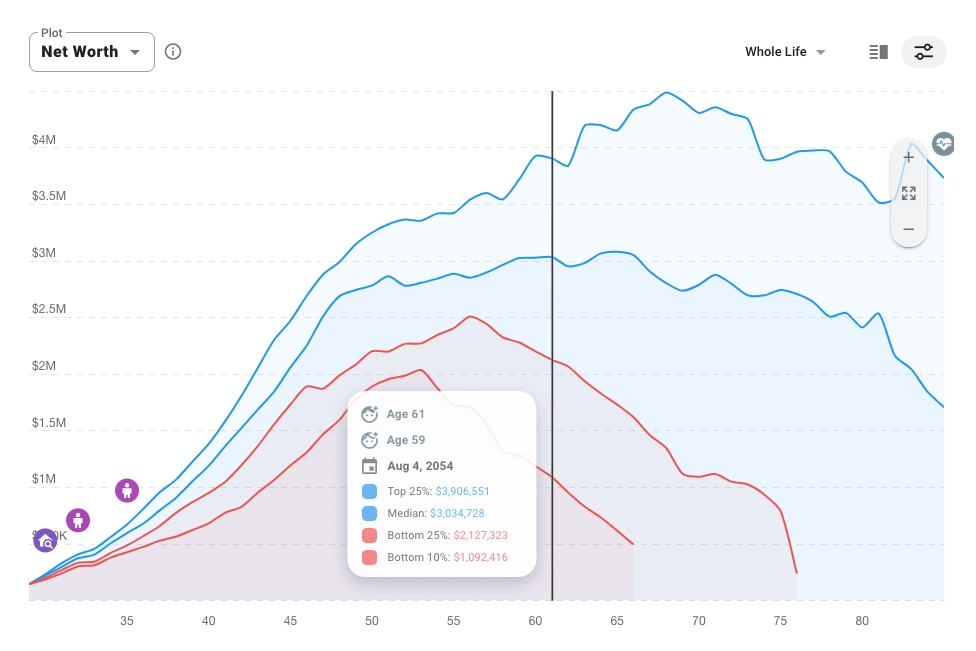
Look at that number. Is it where you want it to be? Are you on track for retirement, or for financial independence by a certain age?
Portfolio Mix
Of everything under net worth, I look at what percentage sits in the stock market (and whether that’s diversified), what percentage is real estate and other investments, and what percentage is liquid cash. Does it feel balanced, or heavily concentrated in one place?
This part is subjective, and I’m not qualified to give financial advice, so I just think about it this way:
Is any one category a majority, meaning over 50%? Personally, I’d rather it wasn’t. For the more alternative stuff (metals, crypto, anything outside stocks, bonds, cash, and real estate), I prefer keeping that percentage lower than some people might. I don’t mind them existing in the mix, I just don’t like relying on them.
Last, I think about liquidity. Real estate and business interests are the least convenient to cash out. What scenarios or risks would require access to that liquidity? These would be genuine emergencies, but if they happened, how much would I actually need, and does my current mix allow for that?
My Gap Analysis for 2026
After laying out my goals and my current picture, I do a gap analysis: where are the gaps between where I am and where I want to be, and what needs to change to close them. Here’s what I noticed doing this myself this year.
Income
I’m really happy that a goal from a couple years ago, shifting my income from my regular job to YouTube, has mostly been achieved. It isn’t any less work than I expected, but it’s more flexible and it feeds my creative side, which is a good match for what I need right now.
I’ll admit it’s more stressful being my own boss. I set unreasonable expectations and deadlines for myself, and “good enough” doesn’t come easily to me. It’s been a real learning experience. I keep coming back to my original reasons: creating useful, non-hypey content I’m proud of, making enough to sustain that, and using it to buy time and flexibility so I have more days that don’t feel rushed with my kids.
If it ever starts messing with that balance, something’s backwards and I need to rethink my approach. The same goes for my real estate ventures. They’ve been fruitful, but time is the most precious thing I have, and that trade-off isn’t something I take lightly.
For 2026, that means paying close attention to how these ventures affect my day to day, and adjusting expectations, streamlining, or delegating where I need to so they keep serving my goals instead of dragging on the whole system.
Expenses
We’ve said food and travel are what we value, and that shows up in how we actually spend. We’ve streamlined a lot, cutting anything that doesn’t matter to us and minimizing choices we’d regret.
One thing I have to share: I recently got a color analysis done (code LYDIA20 for a discount, not an affiliate code, they were just kind enough to share it), where they map out which colors work best on you across the four seasons. The next time I’m renting an outfit for an event, I’ll know exactly which pieces from my cool winter palette I won’t regret. Money well spent. For 2026, I want to keep finding more of these upfront expenses that save you from future regrets, the same way this one did.
On the surprises side, kids’ activities caught me off guard. I’d heard the stories about how out of control kids’ sports and activities can get in the US, and I told myself I wouldn’t be one of those people. I still don’t think I am, sports aren’t our whole personality, but they add up fast between tuition, fees, tournaments, travel, and gear.
We don’t have to do any of this. We’re fortunate to be able to let our kids try different hobbies, and they’ve genuinely gotten a lot out of it. I don’t regret the money spent. What we didn’t have was a ceiling: a maximum amount of time or money we consider reasonable, so some of the line items caught us off guard. A team holiday party sounds fine, then there’s a Secret Santa, fine, then a Venmo link to help fund the party itself. None of these were huge amounts, but none of it felt planned, and there was no clear end in sight.
This year we’ve adjusted our budget to account for how expensive these activities get, especially as the kids get older and more involved. We still want to give them access to these opportunities, but that has to be weighed against everything else we care about. Is it worth cutting travel for? Is it worth working more for? Is there a point of diminishing returns on involvement, and if so, where is it? I don’t have answers yet. This sits right at the intersection of finance and parenting, and I imagine there’s more than one right way to handle it. We’ll keep figuring out what works for us this year.
Net Worth and Portfolio Mix
Both are on track for us, thankfully. As I’ve mentioned before, I’m still adjusting for how uncertain everything feels right now, so we’re targeting a wide range and not making any rash moves. Geographic diversification feels more important than ever these days. Even if it doesn’t matter in the near term, I’d bet the world looks pretty different a decade from now. Overall, I’m happy with where we are, but not getting complacent about it.
What does your 2026 financial gap analysis look like?
Drop us a comment below!
